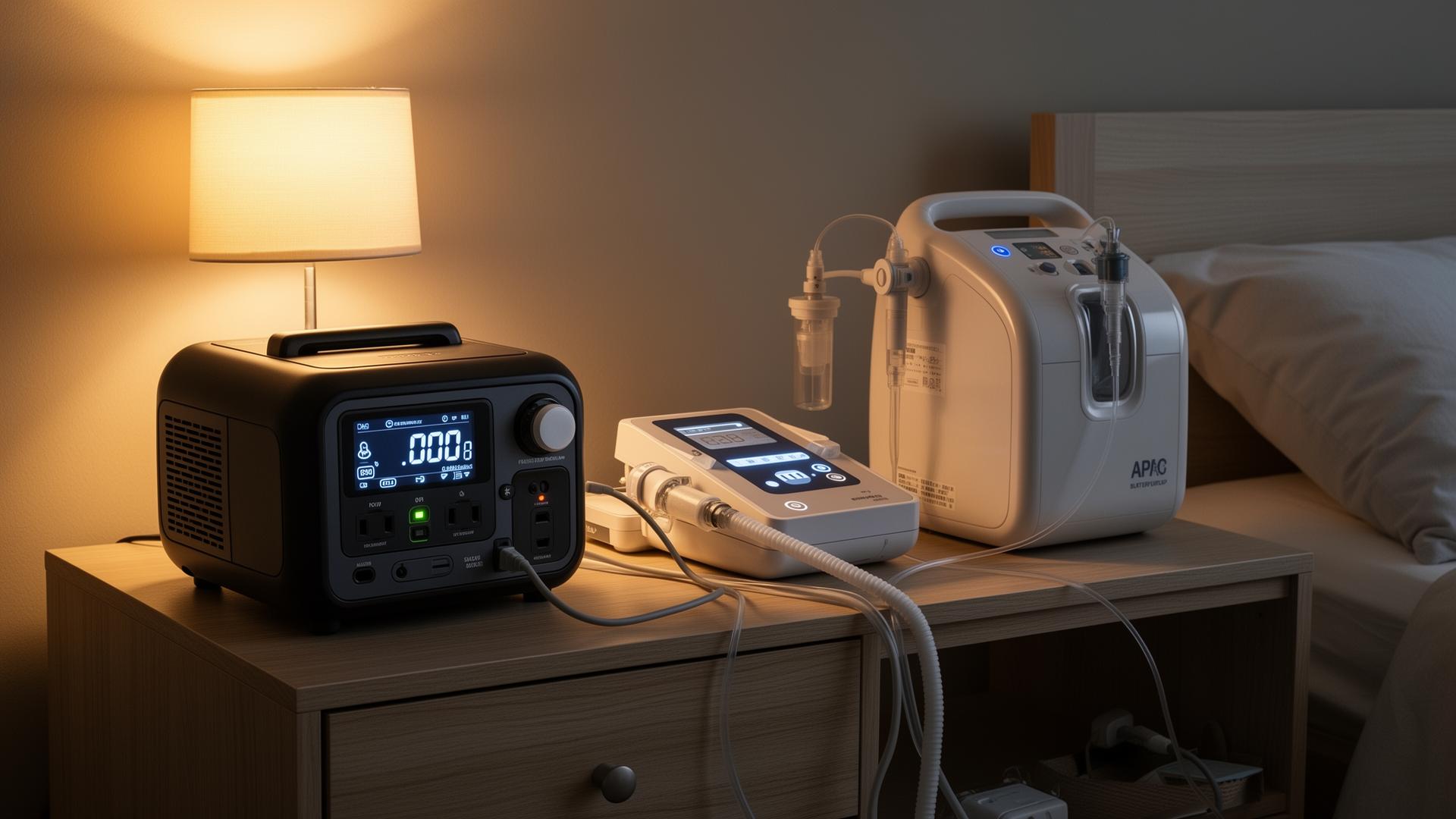
Life-Critical Safety Notice
If you depend on a ventilator or oxygen concentrator to breathe, a battery backup should be one layer of your emergency plan — not the only one. Always have:
- A UPS (uninterruptible power supply) for instant switchover
- Your utility company notified you're a life-support customer
- A backup oxygen supply (cylinders) for respiratory patients
- A plan to reach a hospital or shelter if outage is extended
⏱️ How Long Can You Go Without Power?
Time without power means different things for different devices.
Missed therapy causes fatigue, blood pressure spikes, cardiac strain
Hypoxemia risk — life-threatening for dependent patients
No breathing support — call 911 immediately
Insulin degrades in heat, becomes less effective
Missed doses of critical medications
Nutritional support interrupted
Medical Device Runtime Calculator
Select your devices, set your battery — see how long you're covered
Select Your Devices
30W
Total Load
61.4 hrs
Estimated Runtime
400 Wh
Recommended Capacity
😴 CPAP Users: Your Complete Guide
Over 8 million Americans use a CPAP. Here's exactly what you need to know about battery backup.
Use DC Power
Most CPAPs have a 12V/24V DC input. Using DC instead of AC skips the inverter loss, giving you 20–30% more runtime.
Turn Off Heated Humidifier
The heater doubles power draw (30W → 70W). Use a heat moisture exchanger (HME) filter instead during outages.
Lower Pressure If Safe
Ask your doctor about using a slightly lower pressure during emergencies. Even 1 cmH₂O less reduces draw slightly.
Keep Battery Bedside
Pre-connect your CPAP to the battery nightly. If power drops at 3 AM, you won't even notice the switch.
| Battery Size | CPAP Only (30W) | CPAP + Humidifier (70W) | BiPAP (80W) |
|---|---|---|---|
| 500 Wh | 15 hrs | 6.4 hrs | 5.6 hrs |
| 1,000 Wh | 30 hrs | 12.8 hrs | 11.2 hrs |
| 1,264 Wh | 37.9 hrs | 16.2 hrs | 14.2 hrs |
| 2,048 Wh | 61.4 hrs | 26.3 hrs | 23 hrs |
| 3,600 Wh | 108 hrs | 46.3 hrs | 40.5 hrs |
⚡ Power Station vs UPS vs Generator
Three backup options — here's how they compare for medical use.
| Category | Power Station | UPS | Generator |
|---|---|---|---|
| Transfer Time | Manual (~30s) | Instant (< 10ms) | 10–30s (auto) |
| Runtime | 8–72+ hrs | 15–90 min | 8–24 hrs |
| Indoor Safe | ✅ Yes | ✅ Yes | ❌ No (CO risk) |
| Noise Level | Silent | Silent | 60–80 dB |
| Solar Recharge | ✅ Yes | ❌ No | ❌ No |
| Portability | Good (20–60 lbs) | Poor (heavy) | Poor (heavy) |
| Cost | $500–$3,500 | $150–$800 | $500–$5,000+ |
| Best For | Extended backup + portability | Instant bridging (short) | Multi-day whole-home |
🏆 Top 5 Power Stations for Medical Backup
All use pure sine wave inverters — safe for sensitive medical equipment.
EcoFlow DELTA 2 Max
Perfect for CPAP + extras. 68 hrs CPAP runtime, fast recharge, expandable to 6kWh.
Jackery Explorer 1000 Plus
Lightweight, 42 hrs CPAP runtime. Ideal bedside unit for sleep apnoea patients.
BLUETTI AC200L
High solar input (1,200W). Can sustain a home O₂ concentrator for 5+ hrs, indefinitely with solar.
EcoFlow DELTA Pro
Powers O₂ concentrator + CPAP + fridge simultaneously. Expandable to 10.8kWh for multi-day outages.
Anker Solix F2000
Recharges in 1 hour. Critical when you need to top up quickly between outages.
✅ Medical Power Emergency Checklist
Complete these steps before the next outage.
7 Reasons a Power Station Beats a Generator for Medical Use
Indoor Safe — Zero Carbon Monoxide
Generators produce deadly CO gas and must stay outside. Power stations are silent, fumeless, and can sit right next to your bed.
Instant, Silent Operation
No startup delay, no engine noise. Critical when you need power at 3 AM and your CPAP just stopped.
Pure Sine Wave Power
Medical devices require clean electricity. All major power stations deliver hospital-grade pure sine wave output.
Solar Rechargeable
Pair with solar panels for indefinite runtime. Especially important for multi-day outages in rural areas.
No Fuel Storage
No gasoline, no propane, no refuelling runs. Just charge from the wall or sun and you're ready.
Portable for Travel
Take it to hospital visits, dialysis appointments, or when evacuating. Most weigh under 50 lbs.
Low Maintenance
No oil changes, filter replacements, or annual servicing. Charge it, test it occasionally, done.
❓ Frequently Asked Questions
Can a portable power station run a CPAP machine?
Yes — a CPAP draws only 30–70W. A 1,000Wh battery can run a CPAP for 14–33 hours, and a 2,000Wh unit lasts 28–66 hours. Use DC power mode if available for even longer runtime.
What size battery do I need for an oxygen concentrator?
Home O₂ concentrators draw 300–600W. A 2,048Wh battery provides 3–6 hours of runtime. For extended outages, pair with solar panels or consider a 3,600Wh unit like the EcoFlow DELTA Pro.
Is a UPS or a power station better for medical devices?
Use both: a UPS provides instant switchover (< 10ms) for life-critical devices, while a power station provides extended runtime. Plug the UPS into the power station for the best of both worlds.
Should I use a pure sine wave inverter for medical devices?
Yes - always. Medical devices require clean, stable power. All major portable power stations (EcoFlow, BLUETTI, Jackery, Anker) use pure sine wave inverters, which are safe for sensitive electronics.
Can I claim a power station on insurance for medical use?
Some health insurance plans and HSA/FSA accounts cover backup power for medically necessary equipment. Get a letter of medical necessity from your doctor. Some states also offer rebates for medically vulnerable households.
How do I keep insulin cold during a power outage?
A mini medical fridge draws ~45W. A 1,000Wh battery can run one for 20+ hours. Alternatively, use insulated bags with ice packs as a short-term backup. Insulin is safe at room temp for up to 28 days if unopened.
Don't Wait for the Next Outage
Medical equipment failures during power outages are preventable. See our top-rated power stations and find the right backup for your needs.