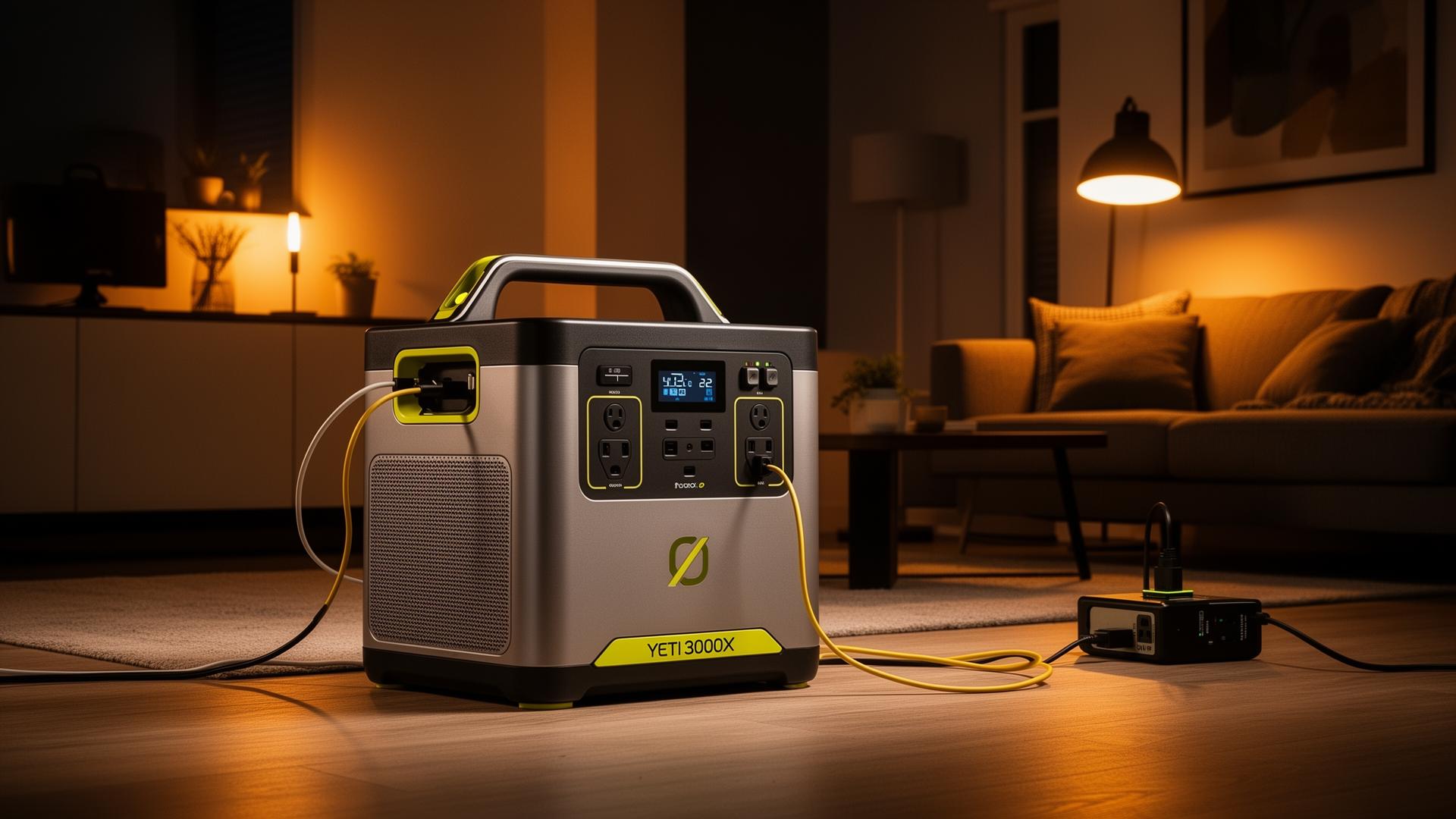
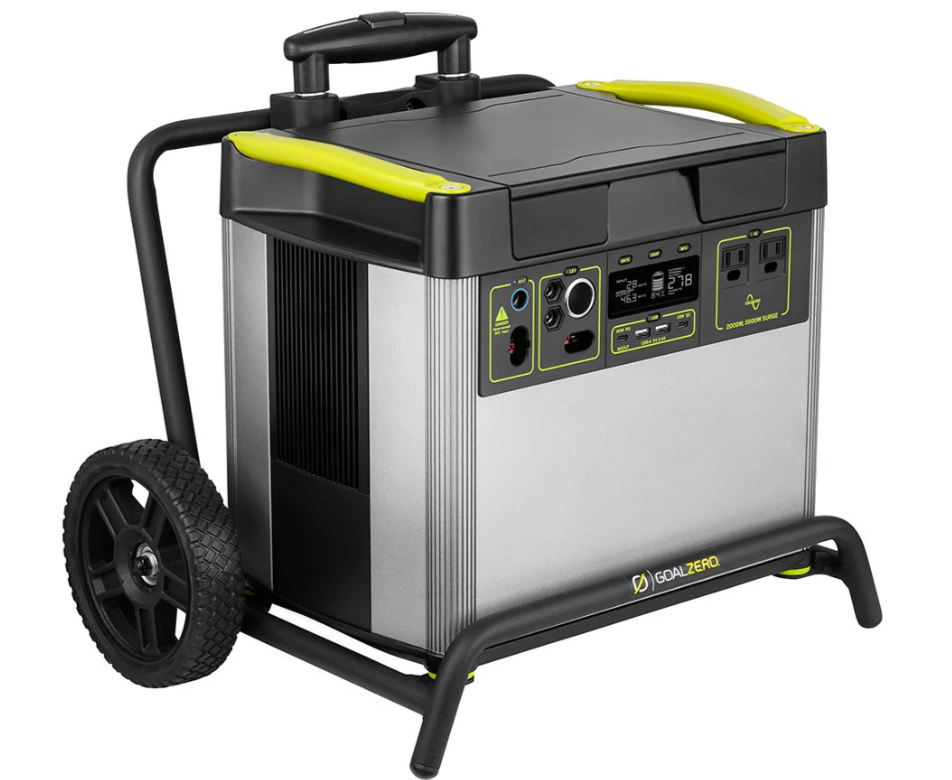
Goal Zero Yeti 3000X
The Yeti 3000X is the premium choice for homeowners and outdoor enthusiasts who value build quality and brand heritage above all else. It's not the cheapest per watt-hour, but it's built to last decades.
Check Price on Goal Zero📊 Key Specifications
3,032 Wh
Capacity
Li-NMC battery
2,000W
AC Output
Surge 3,500W
600W Max
Solar Input
MPPT controller
0–100% in 14 hrs
AC Recharge
Wall charging (6A)
Li-NMC
Battery Type
500+ cycles to 80%
31.68 kg (69.8 lbs)
Weight
Built-in handles
< 35 dB idle
Noise Level
Quiet operation
Wi-Fi + App
Smart Control
Goal Zero app
🛡️ Built Different: Why the Yeti Feels Premium
This is where Goal Zero separates itself from the pack. No other power station matches the Yeti's build quality.
Aluminium Chassis
CNC-machined aluminium body that withstands drops, vibration, and outdoor abuse. This is the most ruggedly built power station on the market.
Stackable Design
Flat top and non-slip feet mean you can stack Yetis, gear, or panels on top. Clean and organised in any setup.
Temperature Resilience
Operates from 32°F to 104°F (0°C to 40°C). Better cold-weather performance than many competitors due to thermal management.
Serviceable Parts
Goal Zero offers replacement batteries and components. Unlike sealed competitors, the Yeti is designed for long-term ownership.
🔌 Port Breakdown
9 output ports covering AC, USB, and 12V needs.
2×
AC Outlets
120V / 16.5A (2,000W total)
2×
USB-A
5V / 2.4A (12W each)
1×
USB-C PD
18W output
1×
USB-C PD
60W output
1×
12V Car Port
12V / 13A (156W)
2×
6mm Port
12V / 10A (120W each)
1×
HPP Port
High-power input/output
1×
Anderson
Chaining port (120W)
Yeti 3000X Runtime Calculator
Select appliances and add solar to see your runtime
Select Appliances
220W
Total Load
12.4 hrs
Estimated Runtime
3,032 Wh
Battery Capacity
🏠 Real-World Scenarios
How far does the Yeti 3000X go in common situations?
Weekend Power Outage
Fridge + Freezer + Lights + Wi-Fi + Phone charging
Handles a full day of essentials with smart load management. Duty-cycle appliances extend this to 16+ hrs.
Off-Grid Cabin
Lights + Laptop + Phone × 2 + Small fridge + Fan
Pair with Boulder 200 panels for indefinite off-grid power. Rugged build handles temperature extremes.
Base Camp / Overlanding
Mini-fridge + Lights + Laptop + Phone × 4 + Projector
Premium camping experience. The Yeti's build quality and stackable design suit vehicle-based adventures.
Medical Backup (CPAP)
CPAP + Lights + Phone + Wi-Fi
Nearly 4 nights of CPAP therapy on a single charge. Pure sine wave output is safe for medical devices.
🔗 Goal Zero Ecosystem
One of Goal Zero's biggest strengths - a purpose-built ecosystem of panels, accessories, and expansion.
Boulder 200 Briefcase
Solar Panel · 200WFoldable, rugged, pairs perfectly with Yeti via HPP
Yeti Link Module
Expansion · N/AConnect two Yetis for double capacity or 240V output
Yeti Home Integration Kit
Transfer Switch · N/AAutomatic switchover for selected home circuits
Goal Zero Torch / Lantern
Accessory · USBPurpose-built lights that charge directly from Yeti USB ports
👍 Pros & Cons
What We Love
- 3,032 Wh - one of the largest portable capacities available
- Premium aluminium build quality - feels tank-like and durable
- Stackable with other Yeti units for clean storage
- Wi-Fi + Bluetooth app control for remote monitoring
- Wide accessory ecosystem (panels, lights, link module)
- Pure sine wave - safe for medical and sensitive electronics
- 2-year warranty backed by established outdoor brand
- HPP port enables faster solar charging vs standard MC4
Watch Out For
- Li-NMC battery (500 cycles) - shorter lifespan than LiFePO4 competitors
- Slow wall charging (14 hrs 0-100%)
- 2,000W output limit - can't run high-draw appliances
- Not expandable with extra battery packs (needs Yeti Link + second unit)
- Premium price for the specs compared to newer competitors
- Only 2 AC outlets vs 4-5 on competitors
🤔 The Honest Take: Specs vs Soul
On paper, the Yeti 3000X loses to newer competitors in almost every measurable spec - slower charging, fewer cycles, lower output, smaller capacity per dollar. But specs don't tell the whole story.
The Yeti is the Land Rover Defender of power stations. It's over-engineered, over-built, and designed for people who keep things for 10+ years. The aluminium chassis, replaceable battery, and decade-long brand track record mean something.
If you want the best bang-for-buck, buy the EcoFlow DELTA 2 Max. If you want a workhorse that your grandkids might inherit, the Yeti has an argument nobody else can make.
⚔️ How It Compares
The Yeti 3000X against the competition.
| Model | Capacity | Output | Solar Max | Recharge |
|---|---|---|---|---|
| Goal Zero Yeti 3000X | 3,032 Wh | 2,000W | 600W | 14 hrs (wall) |
| EcoFlow DELTA Pro | 3,600 Wh | 3,600W | 1600W | 1.8 hrs (80%) |
| BLUETTI AC200L | 2,048 Wh | 2,400W | 1200W | 1.5 hrs (80%) |
| EcoFlow DELTA 2 Max | 2,048 Wh | 2,400W | 1000W | 43 min (80%) |
| Jackery Explorer 1000+ | 1,264 Wh | 2,000W | 800W | 1.7 hrs (80%) |
🎯 Who Should Buy the Yeti 3000X?
Buy-it-for-life enthusiasts
If you value build quality over specs and want something that lasts 10+ years with replaceable batteries, this is your unit.
Off-grid & overlanding
The rugged aluminium chassis handles outdoor abuse. Stackable design fits vehicle builds perfectly.
Goal Zero ecosystem users
If you already own Boulder panels or other Goal Zero gear, the Yeti integrates seamlessly.
Brand-trust buyers
Goal Zero has been in portable power since 2009. For people who buy based on brand reputation, that matters.
❓ Frequently Asked Questions
Is the Goal Zero Yeti 3000X worth buying in 2026?
It depends on your priorities. If you value premium build quality, brand reputation, and the Goal Zero ecosystem, yes. If you need fast charging, LiFePO4 longevity, or maximum output per dollar, newer competitors like the EcoFlow DELTA Pro offer better specs.
How long does the Yeti 3000X take to charge?
Wall charging takes about 14 hours (0-100%) at 6A. Solar charging with 600W of panels takes approximately 6-8 hours in good conditions. This is significantly slower than competitors like the DELTA 2 Max (43 min to 80%).
Can the Yeti 3000X power a refrigerator?
Yes - a standard fridge draws 100-200W with an average of ~150W including compressor cycles. The Yeti 3000X provides roughly 18-27 hours of continuous fridge runtime on a full charge.
What's the battery lifespan of the Yeti 3000X?
The Li-NMC battery is rated for 500+ cycles to 80% capacity. After 500 cycles, it retains at least 80% of its 3,032 Wh capacity. This is shorter than LiFePO4 units (3,000-3,500 cycles) but the battery is replaceable.
Can I chain two Yeti 3000X units together?
Yes - with the Yeti Link Module, you can connect two units for double capacity (6,064 Wh) or 240V output. This is useful for well pumps, dryers, or other 240V appliances.
How does the Yeti 3000X compare to the EcoFlow DELTA Pro?
The DELTA Pro wins on specs: more capacity (3,600 vs 3,032 Wh), higher output (3,600W vs 2,000W), faster charging, and LiFePO4 battery. The Yeti wins on build quality, brand heritage, and repairability. The DELTA Pro is better value; the Yeti is a premium choice.
Our Verdict: 4.3 / 5
The Goal Zero Yeti 3000X is a premium power station that wins on build quality, brand trust, and ecosystem - but loses on raw specs and value per watt-hour. It's the right choice for quality-first buyers and Goal Zero loyalists.
Check Price on Goal ZeroExplore All Our Top Picks
The Yeti 3000X is our premium pick - but better value exists. See how it stacks up against the rest of our reviewed power stations.