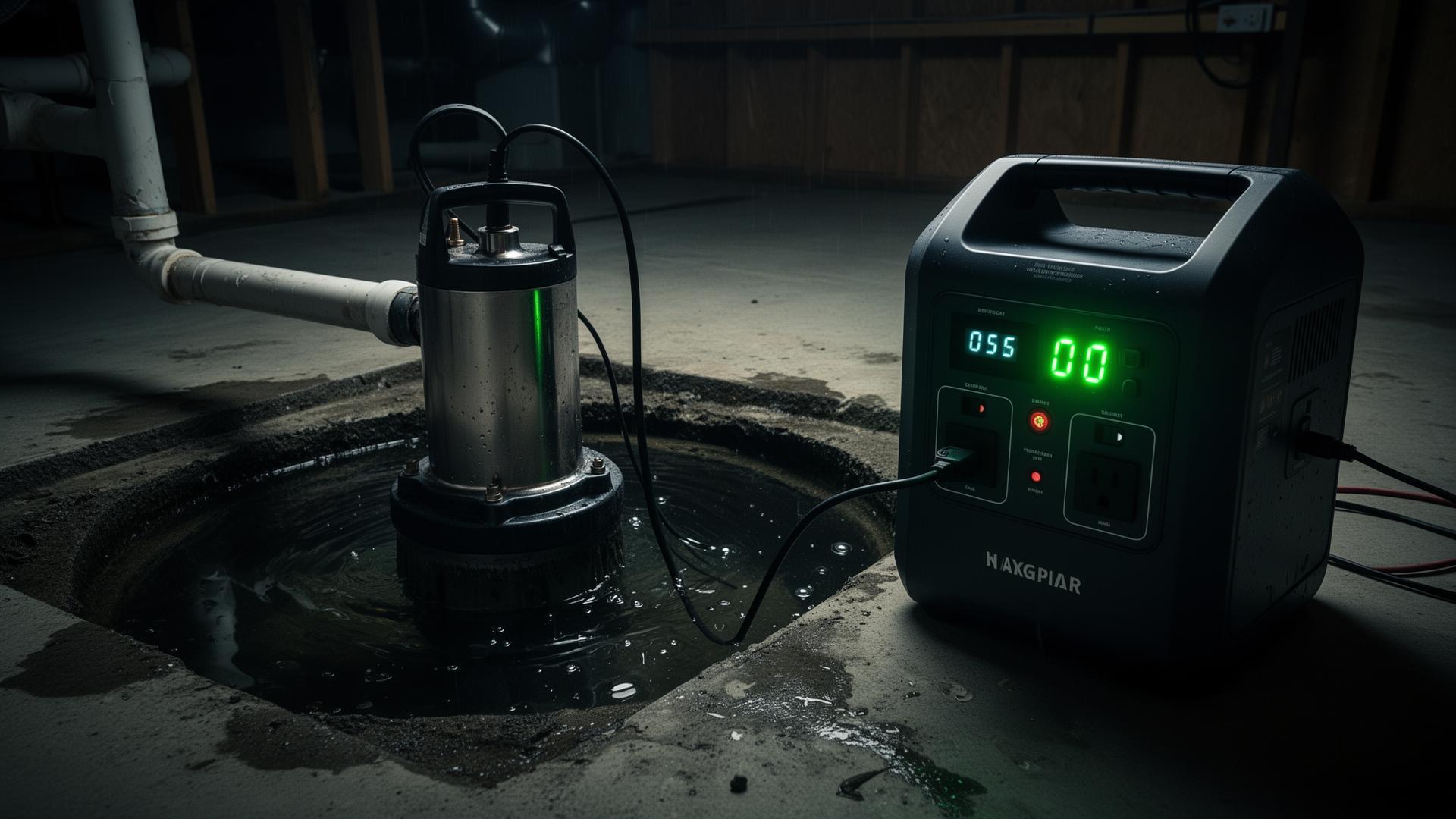
Why Sump Pump Backup Matters
Power outages and storms often happen together. When the power goes out during heavy rain, your sump pump stops - and basement flooding can start in minutes. The average basement flood costs $7,500–$27,000 in damage. A portable power station is insurance that actually works.
73% overlap
Outages + Storms
< 30 min
Time to Flood
$15,000
Avg. Damage
$1,400+
Prevention
💸 The Cost of Basement Flooding
Average repair costs by water depth - and why prevention is always cheaper.
A $1,400 power station could prevent $15,000+ in flood damage - that's a 10× return.
⚡ Sump Pump Power Requirements
The critical number is surge watts - pumps draw 2–3× their running watts on startup. Your power station must handle this spike.
1/4 HP Pedestal
Small homes, light water
350W
Running
700W
Surge
25%
Duty Cycle*
1/3 HP Submersible
Standard residential
500W
Running
1,100W
Surge
30%
Duty Cycle*
1/2 HP Submersible
Most common US homes
750W
Running
1,500W
Surge
35%
Duty Cycle*
3/4 HP Submersible
High water table areas
1050W
Running
2,200W
Surge
40%
Duty Cycle*
1 HP Submersible
Heavy-duty / deep pits
1400W
Running
3,000W
Surge
45%
Duty Cycle*
* Estimated duty cycle during moderate storm (% of time the pump is actively running).
🔋 Sump Pump Runtime Calculator
Select your pump, storm intensity, and battery size to see how long you're protected.
Your Sump Pump
Storm Intensity
Battery Capacity
2,048 Wh7h
Estimated Runtime
250W
Avg. Draw/Hour
1,500W
Surge Needed ✅
🏆 Top 5 Power Stations for Sump Pumps
Every pick here can handle a standard 1/2 HP sump pump. Sorted by overall sump pump suitability.
EcoFlow Delta 2 Max
Handles 1/2 HP with room to spare. X-Boost covers 3/4 HP surges.
Bluetti AC200L
Great price-to-power ratio. Handles most 1/2 HP pumps easily.
EcoFlow Delta Pro
The only portable that reliably handles 1 HP surge. Expandable to 10.8 kWh.
Jackery Explorer 2000+
Add battery packs for marathon runtime. Solid 1/2 HP performance.
Anker Solix F2000
Surprisingly powerful for its size. HyperFlash recharges in 1 hour.
💡 7 Tips to Maximize Sump Pump Runtime
Match surge, not just running watts
A pump's startup surge is 2–3x its running wattage. If your power station can't handle the spike, it'll shut down on the first cycle.
Keep the battery at 100% before storms
Check your weather forecast and charge fully. A half-charged battery cuts your runtime in half — right when you need it most.
Add a battery backup sump pump
A $300 battery backup pump provides 5–8 hours of pumping alongside your power station, buying critical extra time.
Clean the sump pit regularly
Debris forces the pump to run longer and harder each cycle. A clean pit means shorter run times and less energy used per gallon.
Install a check valve
Without a check valve, water flows back into the pit after each cycle — making the pump run twice as often and draining battery life.
Use solar panels for extended outages
400W of solar panels can replace 1,700+ Wh per day in good sun — enough to run a 1/2 HP pump through a multi-day outage.
Test your setup before storm season
Run the pump on battery power for 30 minutes to verify it handles the surge and the connections are solid. Don't find problems during a flood.
Power Station vs Generator for Sump Pumps
Power Station
Gas Generator
✅ Storm Readiness Checklist
Tick off each item before storm season to make sure you're protected.